
From the series the Old and the New (XI)
2010 - Sculpture (Sculpture)
10H x 17.5W inches
Carlos Garaicoa
From the series the Old and the New (XI) by Carlos Garaicoa belongs to the series Lo viejo y lo nuevo / Das Alte und das Neue (The Old and the New) which was first exhibited in 2010 at Barbara Gross Gallery in Germany. Here, Garaicoa’s interest in vernacular Cuban architecture shifts towards the European context: a series of twelve nineteenth-century French engravings have been reworked into delicate paper models. Here, the two-dimensional old-school architectural renderings have become the foundation for new hollow three-dimensional structures. Reminiscent of pop-up storybooks, the small-scale paper forms have also been augmented with black paper shapes, which both resemble the images in a shadow theater and recall abstract modernist forms.
Like many other Latin American artists in the Kadist Collection, Cuban-born Carlos Garaicoa’s conceptual works look at architecture as a palpable indicator of the region’s socio-political and cultural histories. Working since the early 1990s in a wide range of media that includes sculpture, drawing, video, and photography, Garaicoa explores architectural forms and urban landscape aiming to reveal the multiple facets of the modern project’s failure in the Latin American context. His work is influenced in particular from growing up in Havana, a socialist city where unfulfilled utopias meet the traces of an oligarchic past in every building’s facade.
Colors:
Related works featuring themes of: » Architecture in Art, » City Scenes, » Cityscapes, » Color Photography, » Contemporary Conceptualism, » Cuban

© » KADIST
Jiang Pengyi
2008Unregistered City is a series of eight photographs depicting different scenes of a vacant, apparently post-apocalyptic city: Some are covered by dust and others are submerged by water...

© » KADIST
Yang Zhenzhong
2012Peasant Sensation Passing Through Flesh – 3 consists of a massage chair fixed to a wall...

© » KADIST
Mungo Thomson
2014Starting with Bruce Nauman’s iconic artwork, The True Artist Helps the World by Revealing Mystic Truths (Window or Wall Sign) , Mungo Thomson’s neon sign is one of a series that replaces Nauman’s quixotic mini-manifesto with aphorisms from ‘recovery’ culture, especially those made popular by alcoholics anonymous...


© » KADIST
Luisa Lambri
2007Custom-built for a silent film star in 1934 in Santa Monica, the Sten-Frenke House is an idiosyncratic icon...


© » KADIST
Joachim Koester
2007Tarantism is the name of disease which appeared in southern Italy, resulting from the bite of a spider called Tarantula...

© » KADIST
Luisa Lambri
2007Rudolph Schindler’s designs, part of a practice he called “Space Architecture,” marry interior with exterior and space with light...

© » KADIST
Lucas Blalock
2011Compositions such as Tree on Keystone (2011) become hyperreal versions of their real-world equivalents...

© » KADIST
Mungo Thomson
2010In Thomson’s Untitled (TIME) , every front cover of TIME magazine is sequentially projected to scale at thirty frames per second...

© » KADIST
Joachim Koester
2006Physical and mental exploration have been founding elements in Joachim Koester’s research for several years...
© » KADIST
Douglas Gordon
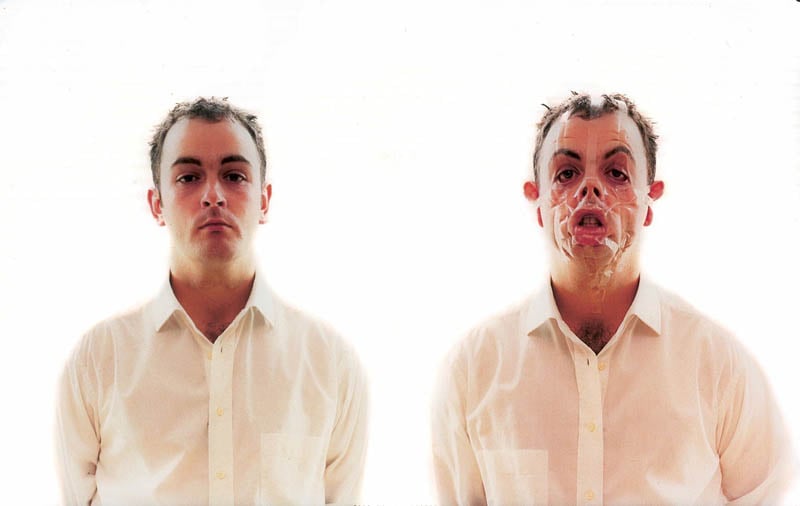
1996In Monster (1996-97), the artist’s face becomes grotesque through the application of strips of transparent adhesive tape, typical of Gordon’s performance-based films that often depict his own body in action...

© » KADIST
Alexandre Arrechea
2006White Corner (2006) is a video installation, projected on two protruding perpendicular walls...

© » KADIST
Mark Bradford
2012This untitled work from 2012 is a print originally made as part of the Wattis Institute for Contemporary Art’s artist limited edition series...


© » KADIST
Yee I-Lann
2013Sarcastically titled to call attention to the problematic notions underlying colonialism, this photograph shows hundreds of Native Malaysians seated quietly behind one of their colonial oppressors...

© » KADIST
Jennifer Bornstein
1994Collectors’ Favorites is an episode of local cable program from the mid-1990s in which ordinary people were invited to present their personal collections—a concept that in many ways anticipates current reality TV shows and internet videos...

© » KADIST
Yee I-Lann
20207-headed Lalandau Hat by Yee I-Lann is an intricately woven sculpture evoking the ceremonial headdress worn by Murut men in Borneo...
